

The Law Society tried to censure me for writing a lawyer's letter
You may have seen the Herald piece this week reporting that the Legal Complaints Review Officer has quashed the disciplinary finding against me and my firm.
I'm not writing to celebrate.
I'm writing because what happened to me is what is now happening, regularly and quietly, to people across New Zealand who don't have the resources to fight back.
A lawyer's letter, fifty years of practice, six complaints
I wrote a lawyer's letter for a client.
The client, a lobby group, was concerned about the use of puberty blockers and other gender-affirming medical interventions on minors.
The letter warned health practitioners that, in light of the Cass Review and the Ministry of Health's own evidence brief, they may face liability for treatments where the evidence of benefit no longer outweighs the sometimes terrible side effects.
The letter was courteous, evidence-based, and entirely orthodox.
I have been writing letters like it for fifty years.
Every major law firm in New Zealand has.
Six people complained. None had received the letter. Two were practising lawyers.
Another was the head of an opposing lobby group, who told the Review Officer he was complaining "as a private citizen."
The complainants disagreed with my client's policy position - and they disagreed with the direction paediatric gender medicine has taken across Britain, Sweden, Finland, and elsewhere since Cass.
They dressed those policy disagreements up as professional misconduct allegations against me.
Censure first, vindication later
The Standards Committee investigated every one of them, and found against me by majority on one ground. They fined me $3,000 and directed a public censure.
That mark would have stayed on me, and on my firm, permanently - appearing on every search of my name forever - had I not sought review.
I did.
The Review Officer demolished the finding at every level. He called the complaints "misconceived."
He said - and I want supporters to read this carefully - that he saw "arguable impropriety" in the complainants' use of the disciplinary regime "as a forum for advancing their opposition" on the underlying policy issue.
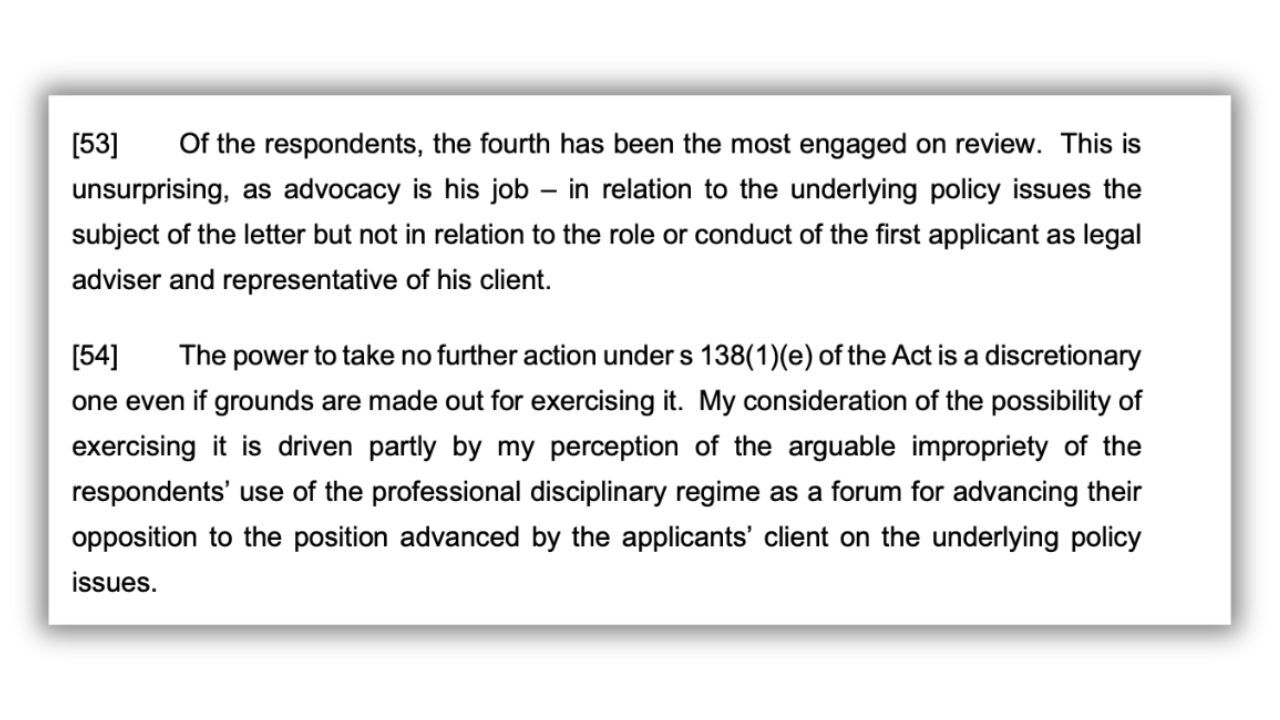
That is a Legal Complaints Review Officer formally observing that a professional complaints process was being weaponised for ideological reasons.
He went further...
He noted that two of the complainants were lawyers, and wondered aloud what their stance would be "if the boot were on the other foot."
Read what the Standards Committee actually told us. It would have been fine, they said, if we'd drafted the letter for the client to send under their own name.
Or if we had written only to the "proper authorities" rather than to the people my client believed were harming children. In other words: the content wasn't the problem.
The problem was that a lawyer's name was attached.
The Standards Committee was telling lawyers to put their standing with the profession's gatekeepers ahead of their clients' lawful instructions.
I could fight - most people can't
I won.
But here's the thing you need to understand. Fighting this took the better part of a year - many hours of my own time and many more of Franks Ogilvie staff lawyers'. I have my own firm, fifty years of practice, familiarity with the regulator, skilled colleagues, and the temperament to keep punching.
I knew our analysis for the client had been top notch. Being proud of our work and not vulnerable to cancellation by big clients meant we could risk a fight in public. If the Review Officer had not been so perceptive, I was prepared to take this through the courts as far as needed.
Most people can't.
A nurse practitioner, a primary school teacher, a junior academic, a doctor in their first decade of practice...
Almost any of them faced with a complaint like this would have folded at the first letter from the regulator.
They would have apologised. Agreed to training. Signed an undertaking, paid the fine, and shut up.
Regulatory power, repurposed
That is what these mechanisms now produce. Not censure of genuine misconduct – but silence.
And worse, the misuse of regulatory power itself.
Professional bodies were given coercive powers to protect consumers from incompetence and dishonesty.
Until recently, it was unthinkable that those powers would be turned into ideological struggle sessions - compelling members to affirm contested political orthodoxies on Treaty partnership, gender theory, and the rest, as the price of staying in their profession.
Parliament must intervene.
The delegated power to punish must be confined to its proper purpose: protecting consumers, and upholding lawyers' duty to represent their clients whatever the regulator thinks of the cause.
This is not only happening in law.
Every profession has a regulator. Every regulator has vague conduct rules - "bringing the profession into disrepute," "professional standards," "respect and courtesy" - drafted for genuine misconduct and now stretched into instruments of ideological discipline.
We are seeing it in medicine. In teaching. In academia.
Our regulators have been captured
I have spent fifty years in this profession. I have served as Chairman of Chapman Tripp, as an MP, and as a committee convenor for the Law Society.
I do not say lightly that the regulatory apparatus of multiple professions has been captured by people whose instinct is to moralise and silence rather than to serve the public.
The Free Speech Union is systematically fighting for the freedom of speech and opinion of professionals against their own regulators.
I am determined to roll back the woke suffocation gagging my profession. You’ll hear more from me on this case.
But the Union is needed for those who, unlike me, can’t do it on their own.
We defended Sue Grey. We are defending Cath Simpson and Christine Massof.
We will defend the next person too.
Stephen Franks | Council Chair
SHARE THIS POST