

Otago Vice-Chancellor's email undermines institutional neutrality within academia
Otago Vice-Chancellor's email undermines institutional neutrality within academia
The Free Speech Union is writing to the Chair of the University of Otago Council this week, asking what steps the Council will take after a recent community email from Vice-Chancellor Hon Grant Robertson took an institutional position on a contested political issue.
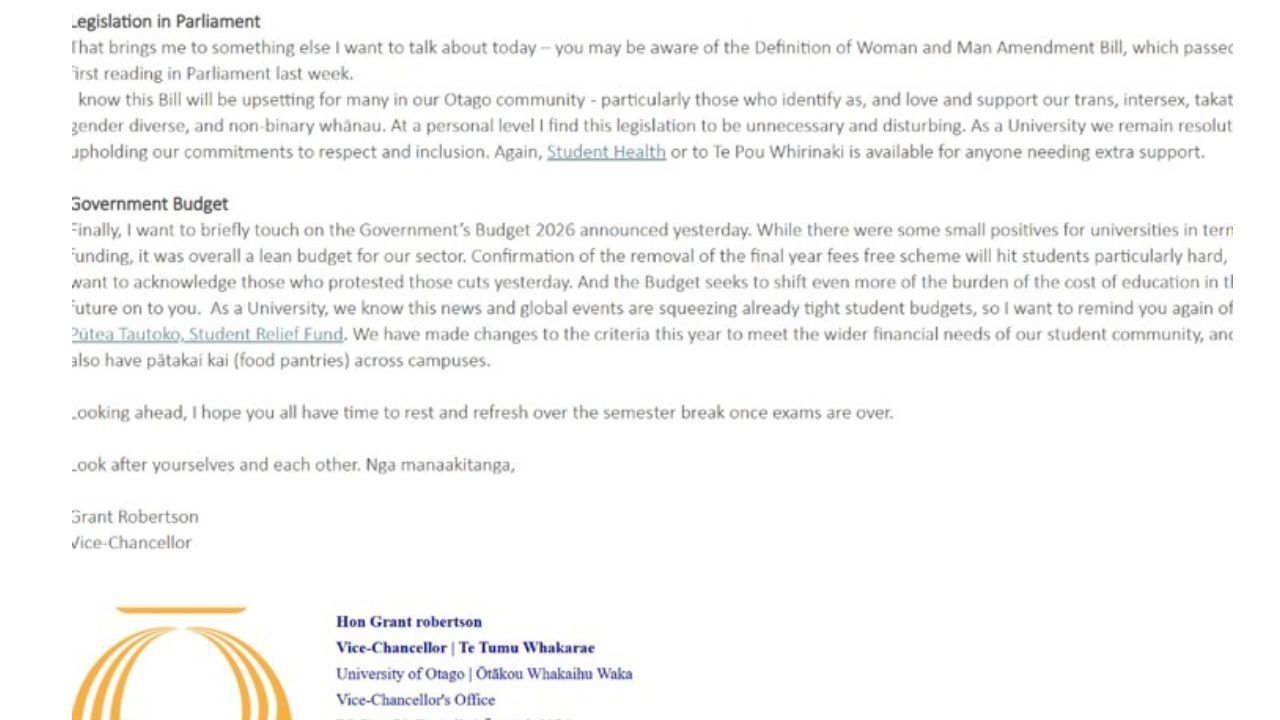
In an email to the Otago community, the Vice-Chancellor described the Legislation (Definitions of Woman and Man) Amendment Bill as "unnecessary and disturbing" at a personal level. He also acknowledged those who had protested cuts in the 2026 Budget, writing that the Budget "seeks to shift even more of the burden of the cost of education in the future on to you."
Steph Martin, Stakeholder Relationships Manager of the Free Speech Union, said the concern was not the Vice-Chancellor offering pastoral support. "Supporting students who feel affected by a Bill is part of his role, and we have no problem with that," she said. "The issue is taking an institutional position on a strongly contested political question. When the Vice-Chancellor signs his views with his title and sends them through the University's own channels, the institution speaks with him - and staff and students who take a different view are left on the wrong side of an official line."
Martin said institutional neutrality existed to protect academic freedom. "A university stays open by not announcing, from the chair, which side of a contested question its members should be on," she said. The principle is set out in Otago's own Statement on Free Speech, adopted in July 2024 - which the Free Speech Union welcomed at the time - and it now carries statutory weight. Parliament wrote institutional neutrality into the Education and Training Act last year, requiring university councils to develop a statement on freedom of expression and to report annually on their actions taken to uphold it.
The Free Speech Union understands at least one student has already raised a formal concern over the email. We will write to the Council Chair this week, and will file an Official Information Act request for the full communication, its recipient list, and any institutional advice given before it was sent.
"We take no position on the merits of the Bill or the Budget," Martin said. "Reasonable New Zealanders will hold a range of perspectives on both, including at Otago. The point is that a university should be a place where they can disagree - including with their Vice-Chancellor."
ENDS
Notes to editor:
The Education and Training Amendment Act 2025 inserted section 281A into the Education and Training Act 2020, requiring every university to adopt a statement on freedom of expression that includes the principle that “universities, as institutions, should not take public positions on matters that do not directly concern their role or functions.” Councils carry a statutory duty to uphold that statement and must report annually to Parliament.
The University of Otago Council adopted its own Statement on Free Speech in July 2024, including a position of institutional neutrality. The Free Speech Union welcomed the Statement at the time as “the new gold standard” for New Zealand universities.
Section 267 of the Education and Training Act 2020 protects academic freedom, including the right of staff and students “to question and test received wisdom, to put forward new ideas and to state controversial or unpopular opinions.”
The Legislation (Definitions of Woman and Man) Amendment Bill passed its first reading on 20 May 2026. Submissions to the select committee close 2 July 2026.
Hon Grant Robertson was appointed Vice-Chancellor of the University of Otago on 1 July 2024.
FSU Media Contact: Jillaine Heather | media@fsu.nz |
www.fsu.nz
SHARE THIS POST